
Nostalgia with Margaret Watson: Why life in Dewsbury in the early 1960s really was the best of times
We all remember a special time in our lives which we look back on as the best of times and one we’d never have wanted to miss.
For me it was the early 1960s, a time in my life when it seemed everything around me was just perfect.
I was 18 and hadn’t a worry in the world because I loved my job as a trainee journalist on the Reporter.
And I’d just met the love of my life (still with him) after he’d just completed his National Service, and life couldn’t have been better.

Life seemed to be getting better for everyone and with good reason because there were plenty of jobs and on the domestic front, people were just beginning to move into new council houses.
Unemployment had never been lower, wages were on the increase, and working class people were at last able to buy their own home if they chose.
Some could even get 100 per cent mortgages and there were new detached houses in Ennerdale Road, Hanging Heaton, being advertised for sale at £3,000.
The National Coal Board had just launched a massive advertising campaign urging young school leavers to become part of what they called their “Big Career in Mining!”.
They were offering good wages, good prospects and good job security. If only those new recruits had had a crystal ball
My brother was one of the many young men who went straight to work in the pit after leaving school at the age of 15.
It was a career choice which benefitted all our family because his new job entitled him to a ton of free coal every few weeks.
No more shivering in the cold for us, which often was the case on cold winter nights when our fortnightly supply of two sacks of coal ran out.
Our family, however, wasn’t the only one to benefit from this sudden abundance of coal now being delivered to our doorstep at regular intervals.
For we often shared it with other families who were always eager to help us shovel it into the cellar and were rewarded with a couple of bucketsful for their trouble.
While my young brother was working underground and earning good money, I was working above ground at the Reporter for considerably less wage.
But how could I compare my cushy office job with the hard, manual graft he and his fellow miners had to put in to keeping the home fires burning.
I also had the wonderful freedom of regularly getting out into the fresh air to report on lots of outside events and able to see how other people lived their lives.
Being a journalist enabled me to mix with people from all walks of life and to observe the vibrant community spirit which still existed in most villages at that time.
I saw great camaraderie among people working in local mills and factories, many of whom had worked there all their lives.
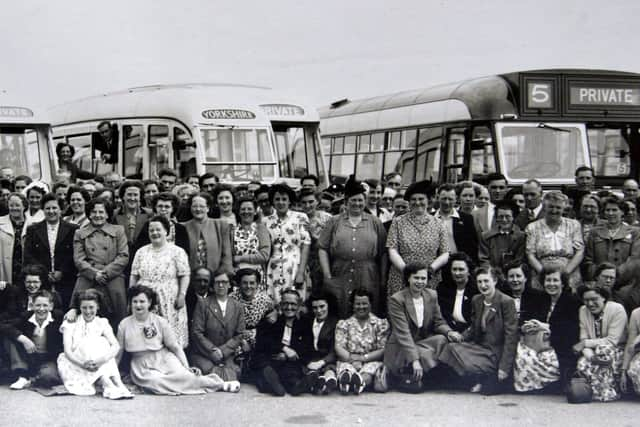
They had Christmas parties, to which they always invited a journalist to report on it, and also invited us to join them on their trips to the seaside – always by bus – as can be seen from this week’s featured photo.
Whatever was happening in our lives at that time, we didn’t mind being shoulder to shoulder with everyone around us, especially on the bus. No social distancing then.
We sat next to strangers in the cinema, on buses and trains, pubs and clubs and restaurants, which, in a way, left us with no alternative but to get on with each other.
Yes, it was the best of times, especially when it came to our evening entertainment, of which there was plenty.
In Dewsbury we had five cinemas as well as live theatre at the Empire Theatre, and there were so many pubs and clubs it was hard to keep count.
Also many dance halls (the night clubs were yet to come) and people of my generation can never forget their first taste of frothy coffee at our beloved Bon Bon Cafe in the bus station.
With so many people all around us, both day and night, it was impossible to feel isolated because there was so much going on.
The 1960s was definitely a great time for young people and it is no wonder we remember our “Rock ‘n’ Roll” years as our golden years.
The very week when local teenagers were stamping their feet to Dave Clark Five’s record “Come on Home” at the Ben Riley Hall, another young Dewsbury lad was making sporting headlines.
He was local rugby league star, Tony Halmshaw, who had just accepted an offer of £1,200 to play for rugby league champions, Halifax, which was believed to be the highest fee ever for a Yorkshire junior player.
The Dewsbury club was disappointed because they’d been confident of getting his services but unfortunately they were outbid.
Still, it enabled them to sign three other young players; second-row forward Stuart Butcher, stand-off half Trevor Davies and full-back Stewart Woods, all aged 19.
Another sporting headline that week was the retirement of Dewsbury swimming instructor, Dennis Grimes, who had taught thousands of young children to swim at the old Dewsbury swimming baths since 1938.
He was presented with a gold watch by Alderman KC Howe, on behalf of the children he had taught and their parents.
Mr Grimes said he had seen many triumphs during his swimming career but nothing had given him a greater thrill than seeing a child swim a breadth for the first time.
There will be thousands reading this article today who will remember Mr Grimes and who learned to swim under his watchful eye. I was one of them.
Happy days!
If you would like to share your memories of the Heavy Woollen District in years gone by, please write to us at [email protected]