
Nostalgia with Margaret Watson: How our dress sense and choice of clothes has changed over the years
There was a time when you could tell a man’s station in life by the clothes he wore and even the poorest of the working classes took a pride in how they looked.
The working man might have had only a few clothes but what he had were generally split into two categories – working clothes and best clothes.
As far as I can remember there were no in-betweens and certainly no such thing as casual clothes. If I’d seen a man walking through town in a pair of shorts, I’d have run for cover.
T-shirts, jeans and anoraks were unheard of, and even if they had been, I could never have imagined dad or any of my uncles having the nerve to wear them.

I never even saw dad in a short sleeved shirt. If he was doing a job at home, he would just roll up his sleeves, and that was the nearest I ever got to seeing a man’s bare flesh in our house.
Like most men at the time, he had a “best” suit he wore only at weekends, usually secondhand, and when it became too shabby to be classed as “best”, it became part of his working attire.
Dad’s trousers wore out quicker than his jackets and so had to be replaced more often, which accounted for his working trousers often being of a different hue to his jacket.
But I am talking about the war years when clothes, like most commodities at that time, were on ration, so perhaps that’s why our clothes were so well looked after.
Dad’s shirts had loose collars attached to his shirt by studs so they could be washed and starched separately. This meant if he didn’t have a clean shirt, there was always a clean collar in a drawer somewhere.
Like most men in our neighbourhood, dad wore braces to keep his trousers hanging smartly, but when he got home he’d let them hang loosely by his side, and that was what they called dressing casually in those days.
I cannot remember him or any other man I knew wearing any other colour of shirt but white, and men didn’t wear tracksuit bottoms, trainers or baseball caps. Perish the thought.
Most working men wore flat caps, and in winter they’d wear mufflers round their necks and on their feet, boots or clogs.
Men in the mills generally wore overalls to protect their clothes from the grease of the machines, while coal miners wore anything they could lay their hands on to go down the pit.
The men I’m writing about are working men, who lived in our neighbourhood, who seemed to adopt the same view on life, sharing the same kind of dress, same hobbies and convictions, and in many ways they were like a brotherhood.
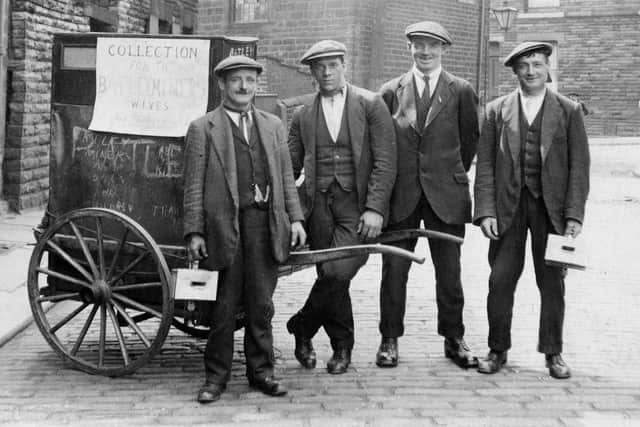
If you look at the working men in the picture taken in Batley in the 1930s showing miners collecting for wives of striking colleagues, I think you might see what I mean. Take a good look at it now.
Despite adversity and great distress and poverty, there they stand looking dignified in their working clothes, flat caps, waistcoats and shiny boots.
It’s while looking through old photographs like these that you can easily see the changes which have taken place in our dress sense.
Today people wear what they want, not what other people expect them to. They seem to prefer casual clothes rather than smart suits, often with designer labels splashed all over them.
They no longer seem to believe in the old maxim that clothes maketh the man, and so dress to please themselves, usually dressing up for work and dressing down for pleasure. And who is to say they shouldn’t.
When I was a child, no matter how poor a person was, they’d always have some clothes they’d keep for special occasions. In the case of older women it might just be a pretty shawl to cover the humble clothes beneath.
I was the youngest of six girls, and so most of my clothes were hand-me-downs, and that’s why I still recall the joy of wearing new clothes at Whitsuntide, clothes no-one else had worn before.
The more I think of those days, the more I’m convinced we get things far too easily today. We’ve forgotten the thrill of anticipation, the joy of looking forward to acquiring new things, the delight of having clothes put to one side for those special days.
I remember the ritual of dad getting ready to go out on Saturday nights. How he hummed happily away as he shaved in the sink corner, while mother pressed his trousers with the flat iron which had been heated on the open fire.
She always made sure the creases were so sharp you could almost cut your finger on them, and then dad would spend ages polishing his shoes with Cherry Blossom shoe polish so you could see your face in them.
Then he would put a folded handkerchief in his top pocket and mother would brush him down with a clothes brush (do they have such things these days?) and he’d set off to the pub with a spring in his step and his mouth organ in his pocket.
It didn’t matter one bit that his suit had belonged to someone else, because it was Saturday night and he had a few bob in his pocket, and he didn’t have to go to work next day.
For a working man in those days, life just couldn’t get better.
If you would like to share your memories of the Heavy Woollen District in years gone by, please write to us at [email protected]