
Heckmondwike student in ‘motivational and memorable’ visit to University of Cambridge after legal essay competition success
Heckmondwike Grammar School is celebrating the achievements of one of its sixth form students who recently excelled in two internationally renowned essay competitions.
Eesaa Dawood took part in the Trinity College Cambridge Law Essay Competition and the John Locke Institute Essay Prize, with his work placing him among the top entrants globally, earning recognition from leading academic institutions.
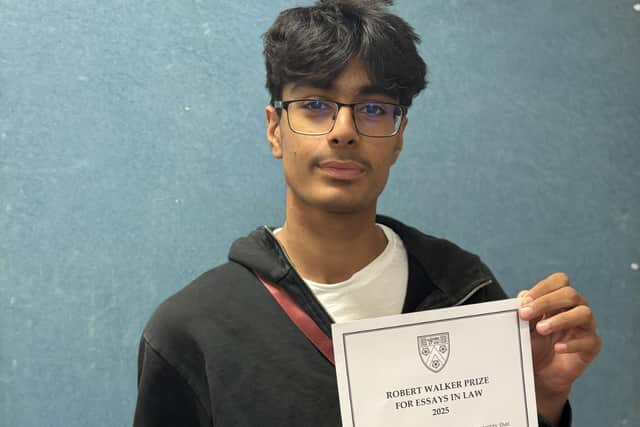

Following his answer - to ‘Should governments provide a publicly funded legal service which is free at the point of access, as many governments provide a free public health service?’ - in the former competition, he received an invitation to Trinity College at the University of Cambridge where he was presented with a certificate, held discussions with the Fellows, and had a tour of the college’s gardens.
For the John Locke Institute competition, he chose the question ‘Should the law treat offenders better than they deserve?’ where he focused on whether strict retributive theories of justice work in practice.
That essay was shortlisted which meant Eesaa was in the top 18.65 per cent of entries - out of a staggering 63,000 of entries from all over the world. The final results of that competition will be revealed this month.
Of his achievements, Eesaa said: “The Trinity College Cambridge Law Essay competition put me in the top ten per cent of entries and I received an invite to Trinity for the prize giving in July.
“The day itself was really nice. There were about 15 of us there, and once we had all received our certificates, we had about 20 minutes of open discussion with the Fellows. We spoke about the ideas brought up in our essays and how different people had dealt with the same question, as well as more broadly about law and Cambridge life.
“It was relaxed but it was definitely stimulating to hear how other people thought about the same issues from completely different angles.
“It allowed me to glean a sense of what studying law at Cambridge would be like, which was both motivational and memorable.”
He went on: “For the John Locke Institute competition, I began by outlining the basic retributive idea that punishment should reflect what a person deserves, then went on to suggest that the idea is more complicated by concepts like moral luck, where something that is out of the control of an individual shapes the choices they made, and the way they and others were judged.
“I then covered ideas like restorative justice, which is focused on being restorative repairing harm and reintegrating offenders – as opposed to predicting or describing previous actions to see what they ‘deserve’.
“The concluding thought I came to was that sometimes the law should treat offenders better than they deserve, not to be soft, but to better realise proportionality, rehabilitation, and ultimately a fairer society overall.”
He added: “Both competitions allowed me to step outside the mainstream A-level syllabus, and to interpret law in a much more independent and creative way.
“The Trinity essay made me really think about the law as a part of the basic infrastructure of society, and the John Locke essay let me, for a little while, go in search of the big ideas surrounding justice and punishment.”
A spokesperson for the school added: “We are delighted to celebrate the outstanding achievements of Eesaa.”