
Batley Stories In A Suitcase: The story of a second-generation migrant who went onto become Deputy Mayor of Kirklees
Mahmood Akhtar came to England at the age of 18 as a second-generation migrant from Pakistan in June 1962.
Now retired and living in Soothill, Batley, Mr Akhtar was part of a large group of Indian and Pakistani nationals who were encouraged to come and work in our local mills throughout the post-war decades of the 1960s and 1970s. These migrants came to Britain because of a severe labour shortage existing during that period across the whole country.
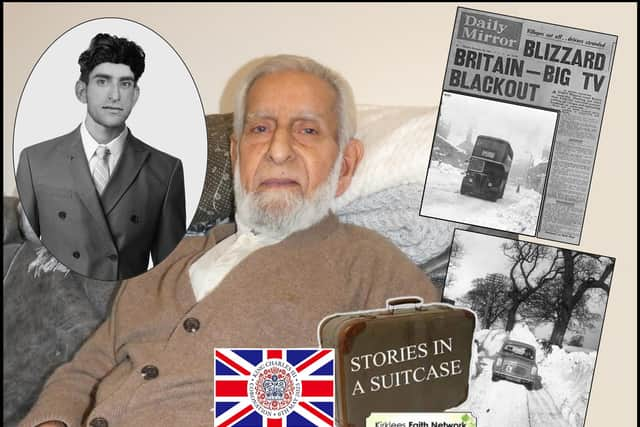

But what was it like for the men who came over to the Heavy Woollen district all those years ago? What did they see? What were their feelings?
As someone who now belongs to a dwindling generation, Mahmood Akhtar has been interviewed by the Kirklees Faith Network’s ‘Batley Stories In A Suitcase Project.’
Mahmood’s story is indeed interesting, starting with his years working long-hours and rotating shifts in the local mills, and later moving on to doing community work. Mahmood’s passion to help others would eventually get him elected as a Kirklees Labour councillor representing his own local Batley East ward for five consecutive terms, followed by a final stint as Deputy Mayor of Kirklees.
This week’s first feature is an account from Mr Akhtar on his experiences of arriving in Batley during the early 1960s.
Speaking to the Reporter Series, Mahmood Akhtar said:
“I was born in a family where the values of education, discipline, and hard work were everything. My father, ‘Master’ Ayath-Ullah, was a schoolteacher in our ancestral northern Pakistani hometown of Bewal. Like others in his profession, my father was affectionately known as ‘Master-Ji’ - a title meaning ‘honourable teacher’ in South Asian society and given to anyone who has dedicated a whole lifetime teaching children.”
Talking about his teenage years, Mahmood said:
“I enjoyed school and passed my Pakistani Matriculation or metric exams - they are equal to the GCSE qualifications in Britain. I then studied at college. It was not so long after qualifying as a shorthand typist from college when I received a letter allowing me to travel abroad to a place called the West Ridings in England.
“A job offer had been typed up in my name on a Heckmondwike based Firth Mill’s official letter headed paper. Some Pakistani men already employed at this large mill had obviously put in good words on my behalf to the management.
“Letters like the one typed for me to come over to England were, due to a strange reason, known as vouchers in those days by the early first and second-generation migrants. These vouchers got sent out regularly to the sub-continent because of the widespread job opportunities available in England during that post-war era.
“Most mill owners, especially up north, were desperate throughout the 1960s to recruit more and more manual workers. I was also one of those young men who came to help fill up the country’s manual labour shortages thanks to a voucher letter from Firths.
“My long nine-hour journey to England carrying just one small suitcase, began on an aeroplane flight from Rawalpindi Airport to Heathrow Airport.
“I had to board another aeroplane at Heathrow, heading towards a rather small Leeds-Bradford Airport where my Pakistani passport was checked and stamped. I then got into a black Hackney taxicab which arrived an hour later outside my elder brother’s small Victorian terrace house situated on Taylor Street in Batley.”
He added: “I came to England in June 1962. The weather over the next several months was a curious mixture of sunshine, heavy mists, and rain showers. Yet the temperatures dropped into their minuses by November. The first snowfalls that I saw began a month later in December and continued into the following year, 1963.
“Heavy wintery snows were a normal part of people’s daily lives in those days and all the shops, schools and the mills remained open. But, the winter of that year 1963 was to be the severest and coldest on record!
“I saw abandoned, empty double-decker buses stranded on the roads, and cars buried under huge piles of white snow. The BBC, along with the tabloid press, famously described this cold snap as ‘The Big Freeze’ because the country’s deepest rivers had even frozen into solid thick ice!
“Despite the harsh weather conditions, I had to walk two miles to work all the way from Taylor Street in Batley to Firth Mills located in Heckmondwike town centre. I walked through heavy rain, fog, sleet, and, of course, knee-deep snow.”
Describing the housing, Mahmood explained:
“Working-class households in those years, including my own brother’s home, had no boilers, no central heating, and no gas fires to keep us warm. We only had coal to burn in the fireplace. As unthinkable as it seems today, the houses did not even have any running hot water. I had to wash the dishes and plates with freezing icy cold tap-water biting into my fingers.
“Otherwise, street-corner laundrettes and public baths were used for washing anything else. But the whole nation came to a standstill after that fierce brutal winter of 1963 shut down everything. Signs written with the word 'Closed' got hung up on the doors of every building, as well as at most shops, offices, and on the laundrette windows.
“Life back then for people like me was a tough one working long shifts, shovelling the snow, and living with frozen blocked pipes.”