
Doctor's Casebook column by Dr Keith Souter: Juggling helps your brain coordination
The sport over this summer has been amazing. As a tennis fan I was pretty well glued to the TV screen during Wimbledon, and like all of the country I have been cheering England on in the World Cup. And then with golf, the British Open.
I was fascinated to see some elite tennis players incorporating juggling into their pre-match routines. Not just with three balls, but while they were side-stepping, or hopping from one leg to the other. It makes great sense, of course, since juggling sharpens hand-eye coordination, peripheral vision, and enhances reflexes.
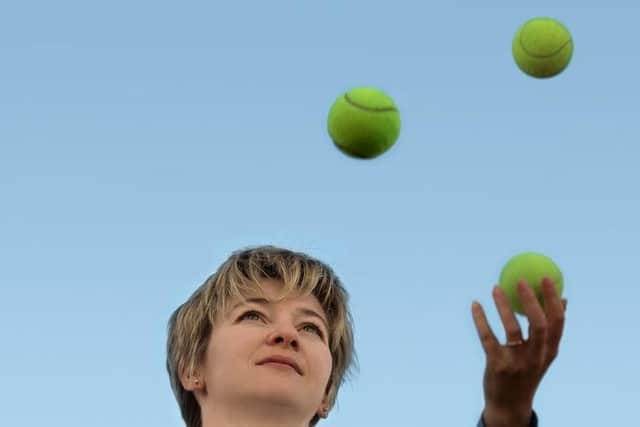

I was actually given a set of juggling balls a couple of years ago, after a family visit to a magic convention when I wouldn’t stop enthusing about seeing amazing juggling skills being performed on a high uni-cycle. I think the balls were meant to silence me, but I took it as a challenge.
Juggling is a skill that had often bamboozled me, so on the principle that one is never too old to learn a new skill, I started practising.
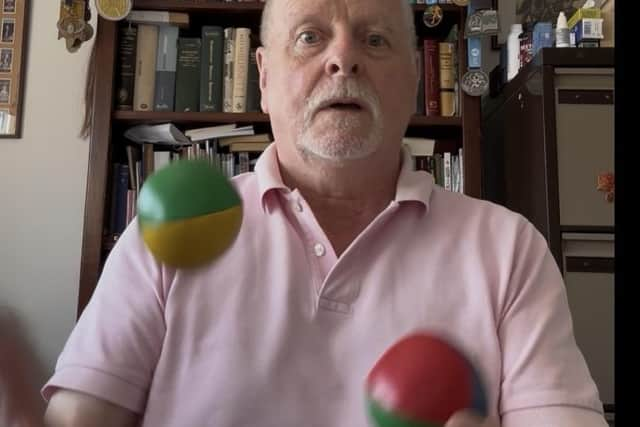
I also really wanted to master the technique because research shows that the learning process in juggling actually helps the brain to stay healthy.
The brain has grey matter and white matter. The outermost surface of the brain is called grey matter, because it has a pinkish-grey appearance. This is made up of the main bodies of nerve cells. This is where most of our cognitive functions take place.
The inside of the brain is composed of white matter. It is made up of axons, or the outgrowths of the nerve cells, which transmit messages up and down to the spinal cord and the nerves of the body.
It has been found using imaging that learning a complex new skill, like juggling, actually boosts the connections between the different parts of the brain by increasing the brain’s white matter.
In one study a group of 24 young adults were given training packs for juggling and asked to practise for half an hour a day for six weeks. Before and after this they all had brain scans using a technique called diffusion tensor imaging. This permits the researchers to assess the structure of the brain’s white matter. Another group of 24 adults were studied as controls, but were not asked to learn to juggle.
After six weeks when the scans were compared, it was found that the non-jugglers’ white matter had not changed. By contrast the juggling group had grown more white matter in the parietal lobe, the part of the brain involved in linking up what we see with how we move. Clearly very important in juggling.
Yet fascinatingly, the growth of white matter happened in all of the jugglers, no matter how proficient some became. The conclusion was that it is the initial learning activity that seems to spur on the brain development. Further practice doesn’t really give any added improvement. It seems that the brain responds to the initial puzzle.
So how am I doing? Well, I’m a bit rusty but watching the tennis players stimulated me to get out my juggling bag of balls. Although I’m not up to hopping from one foot to the other, the skill I learned has not deserted me. And since it’s good for the brain I’m keeping the juggling bag by my desk.