
Nostalgia with Margaret Watson: Before the NHS we would go to the herbalists or local chemist
A new year is beckoning but I doubt if many of us will be making any resolutions because we know we won’t keep them.
Margaret Watson writes: However, there is one I intend to keep and it is to try and record as much local history as I can before I depart the planet.

For, who else but those of my generation who are able to record for posterity the changes which have taken place in our town?
Also the changes which have taken place in our country and how they have impacted on us.
I was born during the war when there was no National Health Service and if people wanted to see a doctor they had to pay for the privilege.
And, if your eyesight was failing you had to pay an optician to test them and then pay for any spectacles he recommended.
Those who couldn’t afford this would buy their glasses from Woolworth’s at sixpence a pair. That’s what my dad did.
Few people had dental checks because they couldn’t afford the dental fees and toothpaste was never at the top of our shopping list.
My eldest brother, Joseph, preferred to clean his teeth with a damp cloth dipped in bicarbonate soda or bleach.
My dad used to pull out his own teeth by wrapping a piece of thread around the tooth and the other around the knob of the oven door.
My mother would then slam the oven door shut which tightened the thread and out came the tooth.
Once when I had toothache I tried it out on myself but luckily mother spotted me just in time.
The next thing I remember was my brother Joseph swinging me up on his shoulder and marching me up the street in search of a dentist.
It was Sunday afternoon and I was five years old, but Joseph assured me Mr Bray, who lived above his practice in Halifax Road, would soon have my tooth out.
Unfortunately, Mr Bray wasn’t in and I started yelling even louder, so Joseph took me across to Dewsbury General Hospital where they sorted me out.
The arrival of the National Health Service in 1948 brought with it many changes, and although it was welcomed by most, mother remained suspicious.
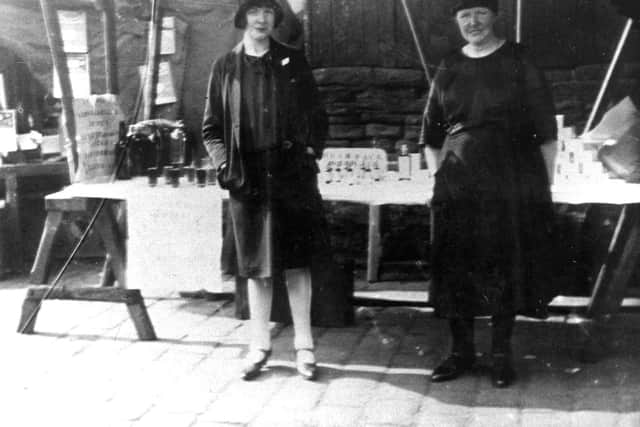
She had always put her trust in the herbalists on Dewsbury Market, or Heughan’s chemist in Kingsway Arcade, who between them took care of all her ills.
If they weren’t there, she would try her own home-made remedies like syrup of figs, brewer’s yeast or lemon and pearl barley, and if she was lacking energy, a bottle of Guinness.
She was convinced these new NHS doctors, dentists and opticians all got ‘commission’ for every prescription they issued, every pair of glasses they sold and every tooth they pulled out
Why else, she said, would everyone in the street suddenly be wearing glasses and flashing new dentures when they’d managed all those years without?
However, she quickly changed her mind when a new woman doctor joined a practice in Bradford Road at the bottom of our street in Springfield.
Her name was Dr Moira Herley, whose father, Randall Herley, was an eye consultant at Dewsbury Hospital.
I believe she was the first woman doctor in Dewsbury and she was young and beautiful and mother thought the world of her.
She could tell a woman doctor what she would never have told a male doctor, especially about any emotional problems she had.
On mother’s first visit, Dr Herley prescribed her a bottle of red medicine which mother said had saved her life. I think it was to calm her nerves.
It was my job to call to the surgery for the prescription on Saturday mornings which I would then take to Timothy Whites and Taylor’s chemist for it to be made up.
I will never forget the morning I tripped up on my way home and to my horror the bottle slipped from my fingers.
I watched the precious red liquid, my mother’s life-saving medicine, running down the pavement and spilling into the gutter drop by drop.
Mother was more upset than I had ever seen her because she was sure she wouldn’t get through the weekend without it.
Looking back I realise that the NHS may have produced remedies for most ills, but I wonder if some of these benefits come with a price – dependency.
For mother’s lemon and pearl barley was no substitute for what that bottle of medicine contained.
And, there was no stall on Dewsbury Market or any herbalist shop from where she could get it.
Before the arrival of the National Health Service, people didn’t go to their doctor’s much, but suddenly now they were there all the time.
The new Welfare state also brought headaches to me personally because suddenly there were nurses and doctors coming to examine us at school, something which had never happened before.
The school optician said I needed glasses and gave me a letter to take home which mother threw straight on the fire.
These opticians weren’t going to get their ‘commission’ through me having to wear glasses I didn’t need, she said.
I was 17 before I got my first pair of glasses, which I paid for myself.
However, the real scourge of the new Welfare State for me was the appointment of education welfare officers.
They were there to make sure nobody skipped school, something which seriously affected me because I was often kept off school to run errands or help look after my grandma.
Our new board school man was Harry Smith, a former wrestler, who made sure I went to school regularly. He wasn’t to be messed with.
Yes, the Welfare State might have had a few drawbacks, but it certainly made sure I went to school and got a decent education.
Without it I wouldn’t be writing this article today. Thank you Welfare State – and Harry Smith!