
VE Day 80th anniversary: Son of Merchant Navy crewman awarded 'Atlantic Star' medal recalls his late father's amazing story of serving in two world wars
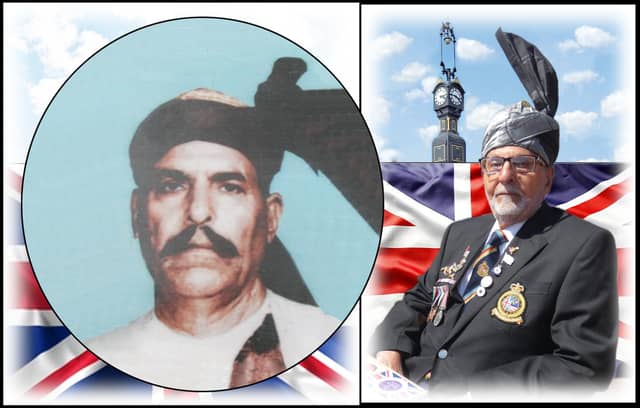

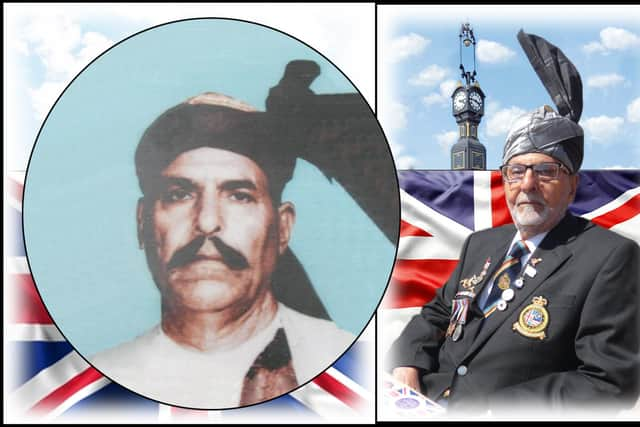
At an event in Heckmondwike New Square on Saturday, May 10, to commemorate the 80th anniversary of VE Day, Mr Mohammad Siddiq turned up proudly wearing his late father's war medals. He came to represent the area's Muslim faith communities.
Mr Siddiq also wanted to use the commemorations and his own father's amazing story to remind people about the many sacrifices made by local Muslims for the war effort.
Born in Kashmir, which was then part of British-India, Mr Ghulam Hussain Bawah came to England in the year 1903. His age was only 19 at the time.
Immediately after arriving from British-India's then main port city known as “Bombay”, Ghulam Hussain Bawah began doing heavy manual loading work on the docks. His hard working ethic eventually paid off, allowing him to quickly find employment on board the Merchant Navy's peacetime cargo freighters.
Ghulam Hussain Bawah also got the opportunity eleven years later to do his bit for “King and Country” when the First World War broke out in August 1914. He did his duty with distinction throughout the Great War, working as a crew member on board the Merchant Navy's convoys.
Speaking to the Reporter Series, his son Mr Mohammad Siddiq, who himself is now aged 91, explained: “My father was actually trained as a frontline British-Indian Army Soldier. But he realised the Merchant Navy desperately needed large numbers of men during the Great War.
“The Germans had submarines known as 'U-Boats' operating everywhere in the North Atlantic Ocean. These U-boats caused massive damage, sinking Allied shipping.
“A lot of innocent men perished whenever their ship was struck by a torpedo. The attacks turned out to be even more deadly when the U-Boats began to gather in what were known as 'Wolf Packs'. Yet men like my father were still ready to risk their own lives just to help feed the nation.
“My father wanted to play his part helping bring vital food supplies, raw materials and other important goods into the country through the dangerous waters of the Atlantic.”
Reflecting on his father's experience, Mr Siddiq said: “My father recalled the Merchant Navy employed men from many different corners of the globe. It was the same situation in the Second World War.
“He remembered there were lots of Arabic speaking crewmen on board the ships. Yet, those from the Kashmir province of what was then British-India made up the majority of the Merchant Navy's 'foreign' crews.
“The working conditions were some of the toughest. Besides their work on the ships, the men had to put up with a tremendous amount of home sickness, claustrophobia and overcrowded sleeping quarters, not to forget the harsh freezing cold weather of the North Atlantic, and most importantly the constant fear of sudden German U-Boat attacks.”
Ghulam Hussain Bawah remained in England and continued working for the Merchant Navy after the First World War ended.
Talking about his father's involvement in the Second World War, Mr Siddiq said: “My father joined the Royal Navy as soon as the Second World War broke out in September 1939.
“His duties in this conflict were to serve as a crewman and as an Urdu/English interpreter. There were other British-Indian crewmen working on the Royal Navy's ships. Yet, they did not really understand the English language like my father used to at that time.
“So, my father had to quickly interpret in Urdu any important instructions especially during an emergency.
“One of the most important instructions was to immediately abandon the ship's lower decks and to run up to the top if a torpedo had struck the vessel. The lower decks were the first areas that obviously got flooded with water as soon as a torpedo made a direct hit.
“Another instruction was for the crewmen not to huddle together into a group while standing on the upper deck, but to stay well apart from each other if enemy planes were attacking from above with bombs or machine-gun fire. A bomb would take them all out in one go if they were in the same place at the same time.”
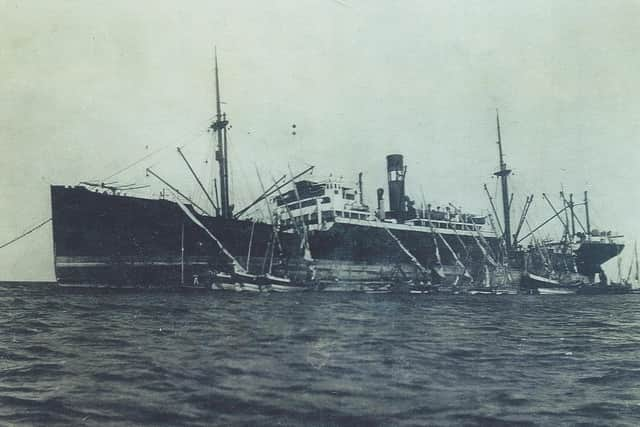
Mr Siddiq added: “My father was actually on board a ship which did get torpedoed. Luckily, the vessel had not exploded, and all the crew, along with my father, were quickly evacuated on lifeboats before the ship capsized.
“There was an English naval officer holding a camera in the same lifeboat as him. This officer was able to take a quick photo of the capsizing ship. He later gave the photo to my father.”
Ghulam Hussain Bawah continued his service with the Royal Navy until he left in 1948. Among his several war medals is the “Atlantic Star” given to all Royal Navy personnel who fought during the critical Battle of The Atlantic. He died in the following year, 1949.
Ghulam Hussain Bawah was posthumously awarded the veterans’ Lapel Badge in 2009 by the Ministry Of Defence. His son, Mohammad Siddiq, travelled all the way to a ceremony held in London where he collected the special badge on behalf of his late father.