
VE Day 80th anniversary: Batley man shares the story of how his late grandfather escaped from a notorious prisoner of war camp
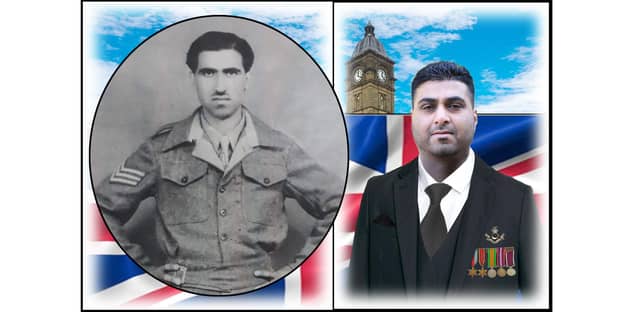

As part of this year's commemorations marking the 80th anniversary of VE Day, Mr Fakhar Bhatti, from Hanging Heaton, has come forward to talk about his late grandfather's experience in the Second World War and to remind people about the many sacrifices made by local Muslims for the war effort.
Speaking to the Reporter Series, Mr Bhatti said: “Like thousands of men from the Punjab province, my grandfather, Raja Gulzar Khan Bhatti, had voluntarily enlisted himself into the British-Indian Army shortly before the outbreak of the Second World War.
“My grandfather felt really proud after getting posted with the British-Indian Army’s prestigious 6th Baluch Regiment where he quickly got promoted to the rank of 'Subedar'. The title 'Subedar' means 'Warrant Officer'.
“His regiment was transported by ship not so long afterwards to Burma, and then to Egypt where he remained until orders came to sail towards England.

“My grandfather was serving in France under the British Expeditionary Force when hostilities broke out with Germany on May 10, 1940.
“He fought bravely as a frontline British-Indian Army 'Sephoy' and was even recommended for the George Cross medal by his superior officers. But after only six weeks of fighting, the French government surrendered on June 21.”
Giving his reasons for the interview, Mr Bhatti explained: “After his death in December 1982, my family members in Pakistan discovered my grandfather had left behind a very interesting diary.
“He had written a detailed Urdu account in this diary of his experience as a British-Indian Army soldier fighting and then trying to survive in Nazi-occupied France.

“I am now sharing some of my grandfather's wartime diary extracts for the very first time with the Dewsbury Reporter Series.”
Continuing with his grandfather's story, Mr Bhatti said: “According to his hand-written diary notes, the war turned out to be a disaster for France. There was chaos everywhere and panic set in amongst the French civilian population from the moment news came through the German Panzers (tanks) had crossed the border.
“The thundering noise in the skies above from the enemy's Heinkel bombers and the screeching sound of Stuka dive-bombing planes was itself too much for the terrified French citizens.
“My grandfather saw thousands of frightened civilians fleeing their homes with packed luggage cases and furniture loaded onto horse-drawn carts, or on lorries and cars, and even on bicycles.
“To make matters worse, so many people were moving on the roads it became difficult for the Allied troops to head quickly towards the advancing Wehrmacht. The human traffic had slowed down everything.
“My grandfather also realised the majority of the French troops had been trained as infantry soldiers ready to fight on foot with guns. They had no idea how to deal with the onslaught of the rapidly fast German motorised divisions.
“The speed of the German 'blitzkrieg' invasion shocked the French and the British. Thousands of Allied soldiers were forced to retreat towards the northern French coastal town of Dunkirk.
“A large number ended up getting evacuated back to England. Yet others, such as my grandfather, did not reach the Dunkirk beaches in time. All these men got rounded up as prisoners of war.”
Mr Bhatti continued: “Although the fighting on French soil had ended, the nightmare was only just about to begin.
“Millions of French conscripts, along with thousands of English soldiers, were herded into POW camps. Most of the English and French speaking prisoners later got sent to work in Germany as foreign labourers.
“But the British-Indian prisoners had to stay in southern France at a notorious camp known as Stalag 315 near the town of Epinal.
“Through his diary, my grandfather talked about the regular beatings in the camp, as well as the poor quality food rations and the contaminated rice handed out to POWs like him.
“The rice seemed to have plenty of salt. But everyone later found out the 'salt' was actually crushed glass deliberately mixed into the cooking by the camp authorities.
“Not surprisingly, most of the men coughed blood after swallowing the rice or soup, and fell seriously ill. The German captors did not treat the British-Indian prisoners as humanely as they should have done under the terms of the Geneva Convention.
“The prejudice and racism, alongside the brutality and abuse suffered at the hands of the SS guards, was terrible. Yet after four long years, the situation changed one day - on May 11, 1944 - when a squadron of American B17 Liberators dropped their bombs on the POW compound - badly damaging its walls.
“At least 800 prisoners, including my grandfather, saw an opportunity to escape. The men immediately grabbed their belongings and made a run for the rubble-strewn bricks - after seeing several openings in the bombed out, damaged walls.
“Most of the inmates were machine-gunned to death whilst running through the debris. Those like my grandfather luckily escaped outside. But others were not so lucky.
“Looking behind whilst running, my grandfather recalled in his diary seeing dead bodies everywhere as he saw his comrades getting shot in the back by the camp's SS guards.
“He remained on the run along with six other escaped inmates in his group. The men even spent three days hiding under a huge haystack in a barn on a farm.
“Everyone had to be vigilant and keep on moving, not knowing where to go until the thought of crossing the border into neutral Switzerland came into my grandfather's mind.”