
Muslim faith communities across North Kirklees join millions around the world to begin Ramadhan fasting
Muslim faith communities across the region in Dewsbury, Mirfield, Batley, Heckmondwike and the Spen Valley have joined millions all over the globe to begin this year's Ramadhan fasting.
The faithful will not eat or drink anything during daylight hours for the next four weeks.
Those who are likely to be fasting shall wake up from their sleep before 5am at dawn to have a large glass of water and a light meal. Nothing is then to be eaten throughout the day for the next 12 hours – until the sun goes down at around 5.30pm.
The times for both dawn and sunset keep increasing by a minute or two every day – meaning the fasting will continue getting longer as the weeks pass.

Ramadhan starts ten days earlier every year in line with the Islamic lunar Hijri calendar. This year, the holy month's first day of fasting began today – Thursday, February 19 – as soon as reports came in that the new moon had been sighted.
The year's first few days into Ramadhan are also coinciding with the half-term holidays for those Muslim pupils attending Kirklees schools.
Most children, along with their families, will spend the next four weeks reading the Koran – besides going to school, fasting and then taking part in the usual compulsory ‘Namaz’ worship.
Fasting is seen as an act of worship by Muslims, along with praying five times a day, and giving charity (known also as ‘Zakat’ or welfare alms).
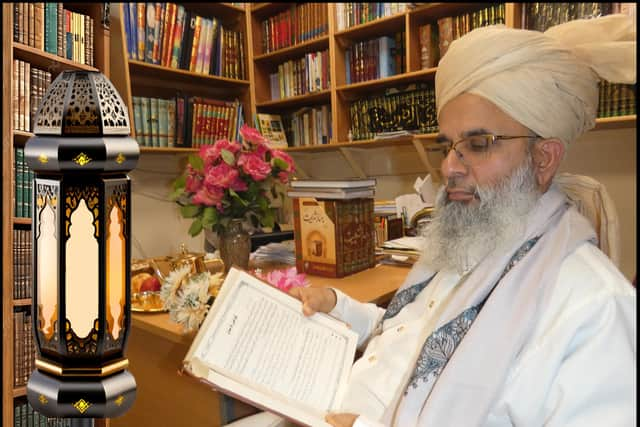
Senior Sufi-Muslim scholar for the Kirklees region, Mufti Shams-Ul-Huda Khan Misbahi, said: “For Muslims, the holy month of Ramadhan is about self-control, as well as staying away from food and water. The person who is fasting does everything only to please the one true Lord.
“According to Islamic teachings, the Lord has given 11 months of the year for Muslims to eat and drink anything Halal. Yet the Lord also asks us to set aside one particular month when there is to be no eating or drinking during daytime – this is the month of Ramadhan.
“Ramadhan is a month for spreading peace, harmony and love. This is a time when the community comes together. It is a time of friendship and a time for giving charity.”
He added: “Medical research is clearly showing that fasting has many health benefits for those who are physically fit to take part in it. Even the majority of diabetics are easily able to adjust their insulin injection times around their Ramadhan fasting.”
The long day's fast ends at sunset when everyone at home gathers around a table covered with a variety of tasty Indian cuisine.
The first bit of food to be eaten is dates, followed by some fresh fruit or dessert, and topped off with a delicious meal.
The men and boys then prepare to attend special congregational ‘Tarawih’ prayers at the local mosque, where a chapter of the Koran is read in Arabic every night. The recitation is done by specially trained ‘Hafiz’ Imams who have memorised the entire Koranic scripture.
According to Islam’s teachings and Biblical history, all the prophets from Abraham, Ishmael, Issac, Jacob, Joseph, Moses, Aaron, David, Solomon, Elyas, Zecheriah, John, Jesus Christ and Mohammad used to fast regularly as a way of getting closer to the Lord.
In Muslim tradition, the prophet Mohammad and his followers always fasted during the month of Ramadhan.
Certain groups of people do not have to fast. These are children under the age of puberty, pregnant mothers, women going through their periodical cycles, the mentally ill, and those who are too frail. Anyone travelling on a long-distance journey is also exempt (but the missed fast has to be made up afterwards).
The senior scholar's words were backed up by a Ramadhan message issued to the Reporter Series from the Sufi-Muslim Imams of North Kirklees, which said: “Our message to the youngsters is to act as ambassadors for your religion whilst you are in school or at your local mosque during this special holy month of Ramadhan.
“Listen to your school teachers in the corridors during breaktimes, and listen to your madrassah tutors at the mosque. Show respect and good manners to these teachers and tutors of yours. Give them the same affection as you would give to your own parents.
“Use this month of Ramadhan by making a pledge to become good role model citizens. Keep this pledge even after the month of fasting comes to an end.”
The statement also had an important message for parents with these words:
“Rather than using your cars, we are advising all adults and parents to walk to your local mosque for the evening's Tarawih worship if the weather is mild. Walking is not only beneficial for your health, but less cars heading to the mosque shall help avoid any congestion around your local neighbourhoods.
“Walk instead with your children to the mosque. Try and discourage your children from going out unaccompanied. Advise them to behave responsibly and to walk back home with you after the worship is over.”
The month of fasting shall end as soon as the new moon is sighted in four weeks' time.
The festival of Eid-Ul-Fitr will then be celebrated, when families come together to enjoy their first daylight meal in four weeks.