
Meet the Batley care home resident and former mayoress of Wakefield who survived nearly two and a half years in a prisoner of war camp during World War II
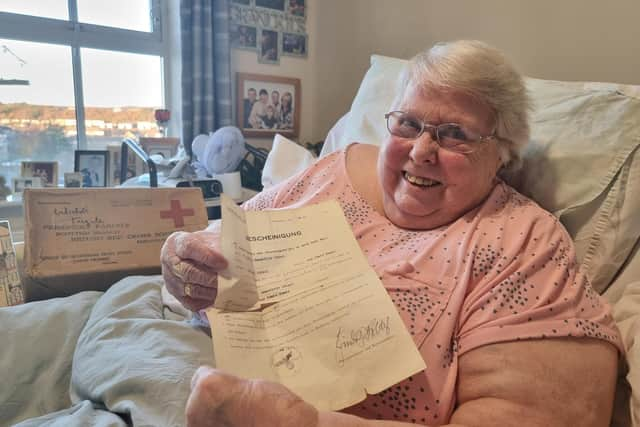
Monday, November 25, marked 80 years to the day since a nine-year-old Elizabeth Cranswick arrived in England when she was repatriated from France after being released from a prisoner of war camp during World War II in France.
Elizabeth was barely five-years-old when she - along with her older brother Frank and their mother Rosa - was rounded up from her grandparents’ French home and taken on a train to an internment camp in 1941 by the Germans.

It was near the start of the Second World War and this was the fate for thousands of British citizens living in France.
The camp, Frontstalag 142 in the Besancon army barracks near the German border, was designated for women and children and would become Elizabeth’s imprisoned home for the next four and a half years.
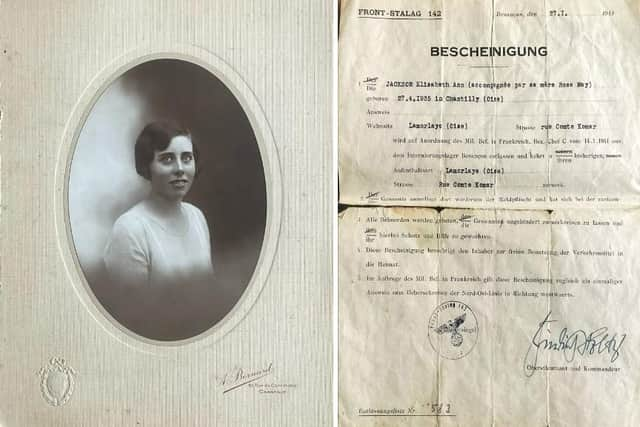
Unlike many others in the camp, Elizabeth lived to tell the tale, which all started with “a knock at the door” from German soldiers.
“The soldiers said, ‘we have come for you,” the now 89-year-old revealed. “One of the soldiers held his gun up and I went to shoot it. I wanted to take my dolls but he said I could only take one.
“They put us on a train. I don’t know where we went to, it was dark. We were on it for a long while. When we got to camp it was one room with six of us in it. It was a bed of straws with bugs and fleas. That’s how we lived until we were sent back home.
“Mum worked in a kitchen so we could get some extra food as all we had were rotten potatoes. That’s what they gave us to eat. It was bad but we just carried on.”
Despite the bleakness, Elizabeth, who is cared for at Batley’s Linson Court Care Home, and Frank had a “mischievous” side within the camp.
“I remember my brother getting into trouble. He got into the warehouse with his friend. If they had been caught they would have been shot.
“They brought the nuns in to look after us as we were so mischievous. I was crying as I didn’t want to go to school.”
Elizabeth, Frank and their mother were released from Frontstalag 142 after enduring two and a half years of internment, as the siblings were under sixteen years of age.
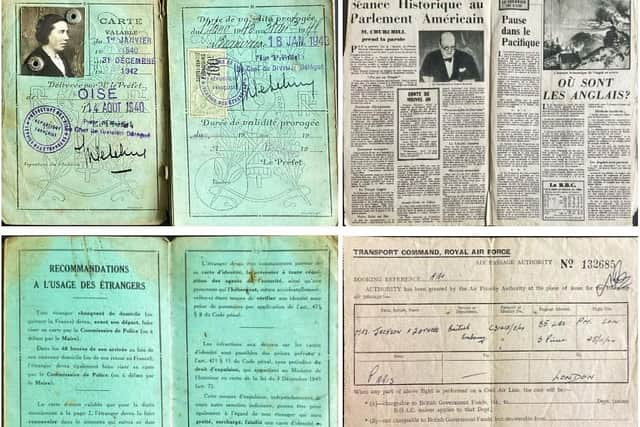
The family were moved back to the village of Lamorlaye, north of Paris, where, as British subjects born in France, they were under constant suspicion and scrutiny of the Germans.
Soon after the D-Day landings in 1944 the village was liberated by the Americans and the family was given papers to repatriate them to England.
Elizabteher remembered: “My brother had a flagpole and he put the English flag up. The Germans told him to take it down or he would be shot.
“We also made a tank out of a buggy with a friend. A convoy chased us but they never found us!”
They were simply innocent children who “took it all for granted.”
“I remember coming home after school at 1pm on a Thursday and the sky went black from one side to the other. I said to one of the neighbours, 'Oh well, someone won’t be having their dinners today.’
“It was just something that happened everyday. We took it all for granted.”
On the day they were finally liberated, Frank was warned by some American soldiers in the nearby woods what was to come.
“To this day I do not remember going from A to B,” Elizabeth revealed. “I saw the planes coming over and the bombs coming out.
“How I ran from where I was to be under the table I do not know. God was with me because I do not know how I got there. Two bombs fell in the field across from our house. We went to look at the craters but nobody was hurt.
“All the young girls that had gone with the Germans had all of their hair cut off. They had to walk around the village square for everybody to see. One of them was my mum’s friends. My mum never knew and she never spoke to her from that day on.”
She continued: “We then went down the main road and we saw the tanks and the dead bodies and the burning bodies. The smell of dead, burning flesh.
“I can still see and smell it now. I went home and never thought anything about it. We were free and that was it.”
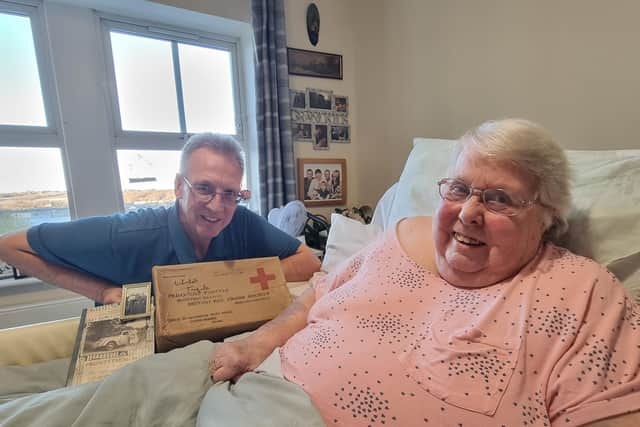
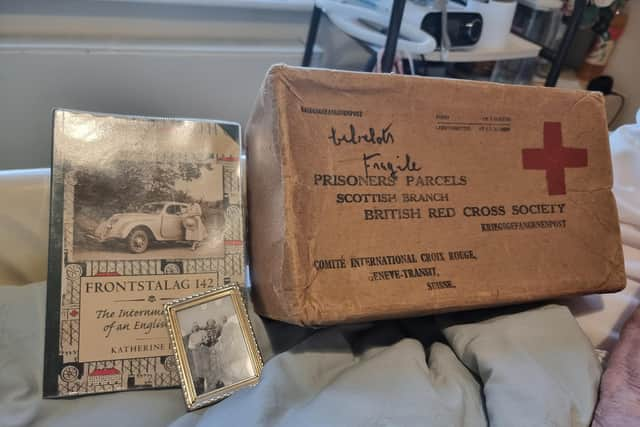
The youngster was diagnosed with double bronchial pneumonia due to the harsh conditions from the camp but was able to fly back to England with a treasured box of mementos - which includes newspaper cuttings, leaflets, clothing, a parachute silk and a Union Jack flag - which is kept at close quarters in her room at Linson Court.
“That box is precious to me,” she said.
Along the way back to England she discovered the beauty of chocolate and the luxury of a flushed toilet.
Elizabeth spent the remainder of her childhood in Radcliffe, Lancashire, before falling in love with a ‘pen friend’, James, who she married in 1956 in New Sharlston, Wakefield.
The couple went on to have two children, Colin, 65, and Ann, 63, four grandchildren, Rachael, Marc, Lauren and Daniel and three great grandchildren, Megan, Mason and Isabel.
They were also the mayor and mayoress of Wakefield in the 1970s.
Colin, who served in the military, said: “We are so proud of her. We knew little bits but we never knew about all of it. She never made it a total secret but she hid a lot of things from us. She has got a ‘make do and mend’ attitude.
“She has the same attitude now that she had then. We call her Bounce Back Betty because nothing gets her down. She takes everything in her stride.
“It has shaped me and my sister. It has made us all very self-reliant. She has taught us to have a bit more confidence in ourselves.”
Life within Frontstalag 142 has been documented in at least two books - ‘Frontstalag 142: The Internment Diary of an English Lady’ by Dr Katherine Lack and ‘Rosie's War: An Englishwoman's Escape From Occupied France’ by Rosemary Say.
These two publications are part of Elizabeth’s precious collection of memorabilia. It is just a shame her mum didn't publish one of her own.
“I wish my mum had written a book,” she reflected.