
Hundreds of people from mosques in Dewsbury, Batley and Heckmondwike gather for Ravensthorpe Eid-Milad Peace Procession
Hundreds of people from mosques in Dewsbury, Batley and Heckmondwike gathered at this year's Ravensthorpe Eid-Milad Peace Procession.
The annual event was organised by the Aslamiya Naqshbandi Jamia Mosque and it coincided with the start of prophet Mohammad's birthday celebrations taking place across the globe.
The colourful Ravensthorpe procession set off with customary tradition outside the North Road place of worship, and was led by local mosque Imams sitting inside an elegant horse-drawn carriage.
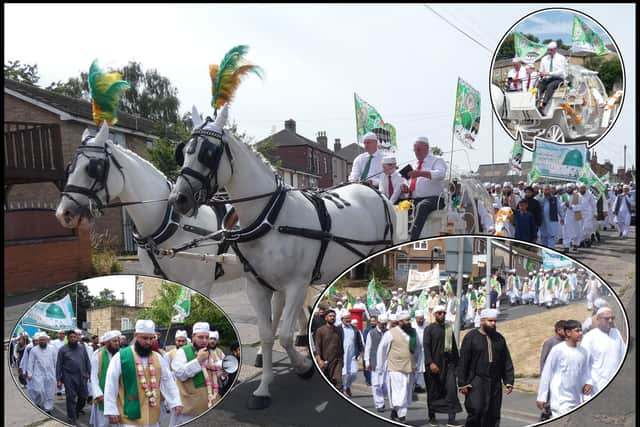

Recordings of religious “Nashid” poems praising prophet Mohammad's birth were aired through a microphone as the peace walk entered several streets. Besides the sound of the lyrical English poetry, those joining in the procession waved green Sufi-Muslim flags. The colour green in Islam symbolises love for nature and the environment.
A large number of the faithful walking in the procession wore white colour tunics and green waistcoats, with white Sufi “topee” caps. White represents purity, peace and love in Muslim culture.
The religious parade returned back an hour later to where it had started and a special prayer service for global world peace was then held outside the Aslamiya Naqshbandi Mosque.
Free mango juice was given to the congregation after the prayer service ended. The drink was also served to members of the public walking past the Mosque during the humid afternoon.
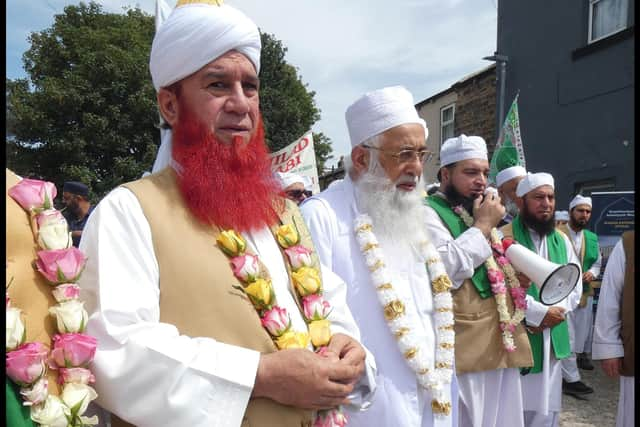
The worshippers later went inside to read their early-afternoon congregational “Zuhr Namaz” prayers.
The faithful got the opportunity after prayers to listen to some speeches on prophet Mohammad's life story and his desire to help others. A hot Indian meal was also served to the congregation after the function ended.
Speaking to the Reporter Series, local mosque leader and the event's main organiser, Sufi Nasir Majid, said: “This year's procession was, as always, well attended, and the warm weather obviously encouraged a better than expected turnout. This was a family orientated religious procession with little children walking alongside their parents and grandparents.
“The idea behind these processions goes back over 1,400 years ago to the story when prophet Mohammad came to settle in what was then the small oasis city of Madina in Arabia. The residents of Madina came out of their homes holding tambourines and singing in the alleys, whilst others stood on rooftops waving at him. That actual historic moment in the city's history was a time of much happiness.”
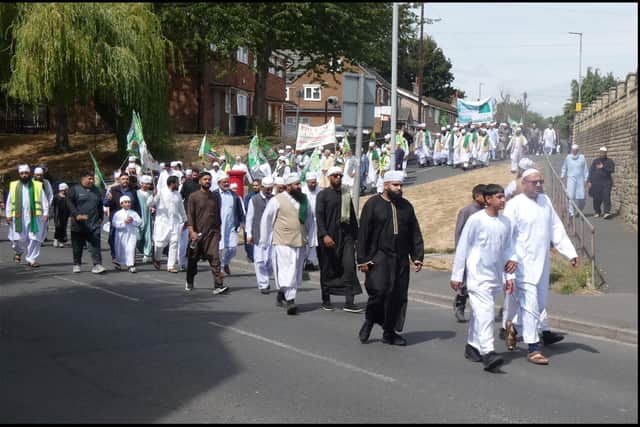
He added: “The purpose of our procession was as usual to spread a similar message of joy, love and peace across our neighbourhoods.
“We also had volunteers walking outside after the peace walk had ended pouring tasty mango flavour milkshake in plastic beakers and giving it to passing residents. The affection and thankful gratitude, especially from our English neighbours, was phenomenally heart-warming and encouraging.”
There are three main Eid festivals in the Muslim calendar, and Eid-Milad is the first celebrated in the month of Rabi-Ul-Awwal, followed by Eid-Ul-Fitr as the second festival celebrating the end of Ramadhan. The final third festival is Eid-Ul-Adha commemorating Abraham's test of faith - taking place place in the Zil-Hajj month.
Families and friends tend to get together throughout the month of Rabi-Ul-Awaal at different homes to read the Koran, as well as to listen to Islamic “Naath” poetry and to afterwards enjoy some food. Houses are illuminated with flickering lights at this time of year. Local mosques are also busy organising their own public Eid-Milad functions.
Because Muslims follow the Lunar calendar, the dates tend to come forward by ten days. The month of Rabi-Ul-Awwal is the Islamic calendar's third month, which this year coincided with the final fortnight in August and the first two weeks of September.