
Heckmondwike Stories in a Suitcase: Haji Mohammad Siddiq shares his first impressions of arriving in Dewsbury in the 1960s
In this feature, Haji Mohammad Siddiq speaks to the Reporter Series about how he came to Heckmondwike as a second-generation migrant from Pakistan.
Now retired from factory work and living at his current address on Staincliffe Road in Dewsbury, Mr Siddiq was part of a large group of Indian and Pakistani nationals who were encouraged to come and work in our local mills throughout the post-war decades of the 1960s and 1970s. These men came to Britain because of a severe labour shortage existing during that period across the whole country.
As someone who now belongs to a dwindling generation, Mr Siddiq volunteered to be interviewed for the Kirklees Faith Network’s “Heckmondwike Stories In A Suitcase Project”.
This feature is an account from Mr Siddiq of what he saw - and lived through - during those post-war years of the 1960s.

He said: “I came to England in December 1959. My age was only 19 years.
“Heathrow Airport at that time was just a small building, perhaps only about three times the size of Huddersfield Town's football stadium. It was not the huge international airport we tend to see today with all those fancy waiting lounges and duty-free shops, along with big multi-storey car parks and vast terminals. All these things were to appear many years later.
“Commercial air travel was still something new in those days. So, the airports were much smaller in that era. I can remember this was certainly the case when our aeroplane landed at Heathrow.
“In my situation, I along with everyone else got off the plane. We were guided into a big room where I saw two smiling white English-speaking clerks dressed in smart suits sat at a table. Next to them was a large coal-lit fireplace.
“Their body language was saying everything. These Home Office officials were so delighted to see us. After all they had their reasons to smile and look happy. The British economy was crying out for manual workers.
“I would, only a few months later, fully understand how eagerly the mills in England desperately needed and wanted to employ young men like me.
“The officials gratefully stamped my passport, as well as the passports of all those other Pakistani passengers who had come on the same plane. No-one at the airport asked us any questions. Soon everyone began to make their way outside.
“We were now in England! All I had in my hands at that moment was one small suitcase, along with just £5 in my pocket!
“I and two other men got a black-cab from outside the airport. The M1 motorway was still under construction at that time and only partially ready.
“Our cab driver decided not use this new road. He instead drove his vehicle on some long country lanes towards our destination - which was the city of Birmingham.
“Our taxi fare from Heathrow Airport to Birmingham was only £3 for that entire 100-mile journey. But £3 was a lot of money in those days. We decided to split the costs by paying a pound each to the driver.
“I stayed in Birmingham for a few weeks before moving further north to the West Yorkshire region or 'The West Riding' as it was known in those years. The snow had already begun to fall when I arrived in the Heavy Woollen District.
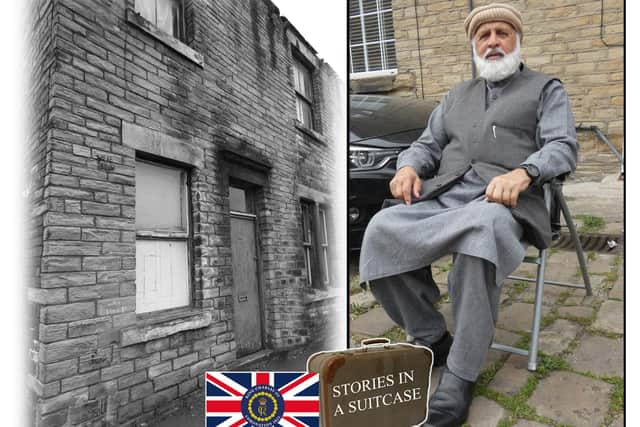
“My first 'stop' was to stay in a small terraced house on Huddersfield Road near St Paulinus Church in the Westtown area of Dewsbury. But the terraces on Huddersfield Road were soon due to be demolished as part of a local slum clearance programme.
“So, I eventually moved to live at a house in Liversedge, near Heckmondwike, with some older first-generation British-Indian Army veterans. All these men had fought as soldiers during the Second World War.
“The property in Liversedge had no gas or central heating. It was like this in all the dwellings. Gas heaters were not yet being manufactured to get sold in the shops.
“Instead, the living room in my new home had a fireplace made only for burning coal. These coal-lit fireplaces kept our homes warm. Smoke from the coal went up the chimney and out into the open air.
“Coal was so very cheap to buy in those days - and it used to get delivered to our homes. In fact, life was impossible to survive without coal.
“A sack of coal only cost about one shilling - or five pence in today's language. We stored it in the cellar. But it was like gold or 'Manna Bread' from heaven!
“The burning coal fires were amazing. Heat from these fires used to warm up the whole living room.
“I suppose the coal fires had to be warm because there were no UPVC double-glazed windows in those days to keep away the cold air from outside.
“The window frames were made of wood with only a single thin glass pane in them. Water was always dripping down the cold glass, and very little light came through even during daylight hours due to the thick condensation.
“Unless you rubbed the condensation off with your hand, nothing could hardly be seen out of the glass, especially if it was raining or snowing heavily outside.
“Cold freezing air always came from the wooden window frames, and this cold air also got through under the doors.
“There was no gas central heating to keep our home warm. Only a gas cooker stood in the small kitchen which was obviously used for cooking. Yet, even cooking meals was a difficult task.
“I can remember there were no Indian takeaways or Pakistani restaurants in that 1960s decade. Our numbers in Heckmondwike were so tiny we could not even take the identity of a community.
“So, to think of having just a small Pakistani corner shop or a small Pakistani cafe in our neighbourhood during those post-war years was clearly something out of the question.
“Snacks like samosas and kebabs were nowhere to be seen in that era. Today, we take them for granted. Anyone these days can walk into some of the most unusual places like a petrol filling station to buy a tasty hot kebab sandwich or a samosa burger. But my generation did not have this choice during the 1960s.
“Samosas and kebabs have now become an important part of British teatime culture. It's one of many popular things Pakistani Muslim culture has given to modern Britain.
“Yet these samosas and kebabs were not even sold in the first 'Asian' grocery shops which slowly began to open up in our local area by the early 1970s.
“We counted ourselves lucky some local poultry farms had live hens to sell. Otherwise, there was not even any Halal meat for us.
“The name for hen is 'Murghi' in the Urdu language. A 'Murghi' hen could be bought for only a shilling (five pence). The 'Murghi' was always cooked in our Muslim Halal dietary tradition at home.
“I can remember a lot of our white English neighbours would trap wild rabbits in those days, and bring them home to cook into a hot stew. Yet it was Halal 'Murghi' cooked similar to a stew in our houses.
“But not every evening was a halal 'Murghi' treat. Vegetables cooked with herbs was one of the main meals for most of the time. A simple cup of 'Chaa' or tea was our morning breakfast.
“Many working class people in those days lived simple - yet disciplined - modest lives when it came down to housing, furniture and also food.
“It was the same for the first-generation and for us second-generation British-Pakistani residents. We were willing to live without a lot of life's luxuries.
“Family and friends were far more important to us than material items or even good quality food. We were always grateful for whatever little we had in those years.”