
Batley Stories In A Suitcase Project: How Mahmood Akhtar adapted to life in the Heavy Woollen District in the 1970s
Mahmood Akhtar came to England at the age of 18 as a second generation migrant from Pakistan in June 1962.
Now retired and living in Soothill, Batley, he was part of a large group of Indian and Pakistani nationals who were encouraged to come and work in our local mills throughout the post-war decades of the 1960s and 1970s. These migrants came to Britain because of a severe labour shortage existing during that period across the whole country.
But what was it like for the men who came over to the Heavy Wollen District all those years ago?
As someone who now belongs to a dwindling generation, Mahmood has been interviewed by the Kirklees Faith Network’s “Batley Stories In A Suitcase Project”.
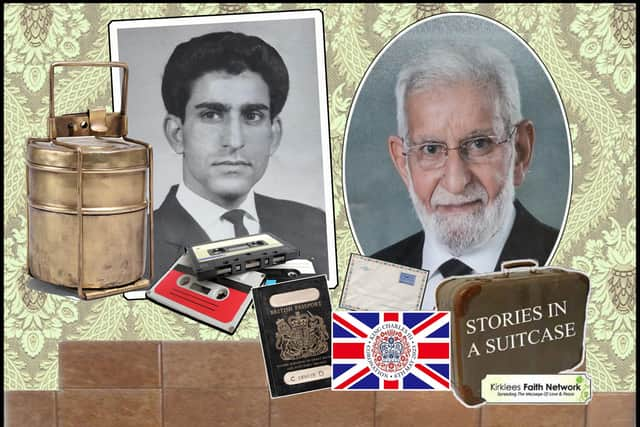

Mahmood's story starts with his years working long hours and rotating shifts in the local mills, and later moving on to doing community work. His passion to help others would eventually get him elected as a Kirklees Labour councillor representing his own local Batley East ward for five consecutive terms, followed by a final stint as Deputy Mayor of Kirklees.
The previous “Batley Stories In A Suitcase Project” feature on Mahmood looked at his early experience of working in local factories, alongside doing voluntary activities, and how they had together strengthened his beliefs around equality and social justice. He had also spoken in that interview about his memorable long holiday to Pakistan and Afghanistan.
This article is an account from Mahmood on what his busy life was like for him in 1970s Batley.
Speaking to the Reporter Series, Mahmood said: “My long vacation to Pakistan during the year 1970 made me appreciate the value of private transport.
“As a tourist, I had travelled the length and breadth of my ancestral Pakistani homeland sat in overcrowded buses and on busy trains. Yet, I realised the sightseeing adventure would have been far better if I had my own car.
“One of the first things I therefore did immediately after returning to Batley from my holiday was to book some driving lessons.
“I passed my driving test in the spring of 1971. It was a simple 'practical' in those days. My generation did not have to sit any theory tests.
“Taking driving lessons seemed much easier in that era since there was far less traffic on the roads, and hardly any vehicles 'pulled out' of the cul-de-sacs. All that was seen on those cobbled 'side' streets was groups of noisy boys kicking worn out footballs and empty Coca-Cola cans.
“I often think about the huge contrast – and how computers, mobile phones, the internet, social media and digital technology – have these days changed the face of our neighbourhoods. The kids are mostly upstairs in their bedrooms hypnotised by gadgets like the PlayStations. The streets are now ever so quiet.”
Talking about his community work, Mahmood said: “Thanks to my car, I was now able to visit the town's local Pakistani residents in their homes if anyone for example needed a lift when attending hospital appointments.
“Having my own car was also a personal luxury for me. I no longer had to wait at the bus stop in cold rainy weather holding the thermos flask and steel lunch tiffin case in my shivering hands. Everything now stayed warm and dry whilst I drove to work.”
Explaining what motivated him to serve others, Mahmood said: “I saw volunteering as a noble service – especially when helping the highly disciplined former British-Indian Army soldiers who insisted upon doing everything according to the rule of law.
“But understanding the English language proved difficult for a generation born in the Indian Sub-Continent – and even local war veterans’ associations at the time knew very little about them. The prejudice and racism in 1970s Britain also did not help their situation.
“Despite being sidelined by mainstream society, this first generation of ex-servicemen were nonetheless entitled – by law – to apply for British Naturalisation or 'nationality' certificates.
“The loyal former British-Indian Army men had been working across the Heavy Wollen District's various different towns since the 1950s. They had made their huge contribution keeping post-war production moving in the local textile mills.
“The demands on me as a result grew throughout the 1970s as the former soldiers (now naturalised as British citizens) gradually began to bring over their families. I was kept busy with tasks like accompanying parents to enrol their children at local schools, as well as filling passport application forms.
“It's easy to forget the 1970s was an era when there were no translators or bilingual staff in our schools and hospitals. So, I felt glad to assist those who had no one to interpret for them.
“I also continued helping people by writing letters in Urdu to their loved ones. But the culture of writing airmail letters slowly began to decline when everyone started using audio cassettes for recording personal messages.
“Sealed in an envelope, the audio cassette was posted over 5,000 miles away to Pakistan.
“To actually hear a family member’s pre-recorded voice in Pakistan through an audio cassette sent by post from England was a novelty long before we had mobile phones and WhatsApp.
“Besides the audio cassette's sudden popularity, friends and relatives still kept knocking on my door for help throughout the next two decades. I meanwhile began to understand 'the system' – knowing exactly what to do when 'signposting' individuals towards different services."