
Batley 'Stories in a Suitcase': How Mahmood Akhtar's language skills helped him play a key role in the community
Mahmood Akhtar came to England at the age of 18 as a second generation migrant from Pakistan in June 1962.
Now retired and living in Soothill, Batley, Mahmood was part of a large group of Indian and Pakistani nationals who were encouraged to come and work in the area’s local mills throughout the post-war decades of the 1960s and 1970s.
These migrants came to Britain because of a severe labour shortage existing during that period across the whole country.
But what was it like for the men who came over to the Heavy Woollen District all those years ago? What did they see? What were their feelings? How were they treated by the local area’s white English speaking population?
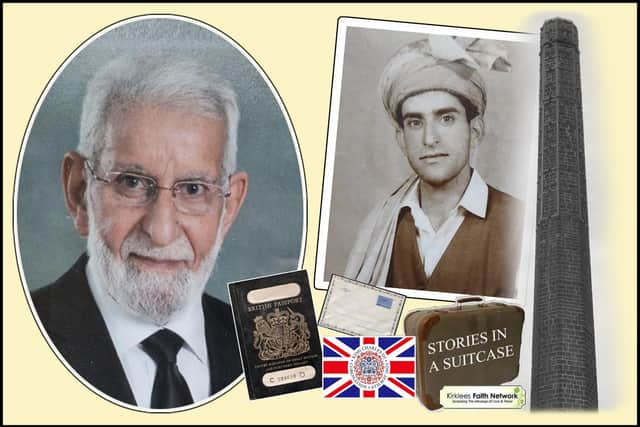

As someone who now belongs to a dwindling generation, Mahmood has been interviewed by the Kirklees Faith Network’s “Batley Stories In A Suitcase” project.
Mahmood's story starts with his years working long hours and rotating shifts in the local mills, and later moving on to doing community work.
His passion to help others would eventually get him elected as a Kirklees Labour councillor representing his own local Batley East ward for five consecutive terms, followed by a final stint as Deputy Mayor of Kirklees.
Mahmood's first feature looked at life in the early 1960s - and how he coped the famous “Big Freeze” winter of 1963. This week's second article is an account from Mahmood on why he began doing voluntary community work.
Speaking to the Reporter Series, he said: “After learning Urdu and English at school, I went onto college where I qualified as a shorthand typist.
“I could speak, read, write and type in the English language. Such qualities were rare in 1960s rural Pakistani society. Anyone who had a typist's certificate was looked up to with tremendous respect in those days.
“News about these skills of mine eventually reached my elder brother, who at the time was living over 4,500 miles away in a small, terraced house on Taylor Street in Batley.
“I was therefore not surprised when an offer of employment - typed on a Heckmondwike based Firth Mills letter-headed paper - was sent to me by post. That 'voucher' letter changed my destiny, and I arrived in Batley during the summer of 1962.”
Talking about how he started doing community work to help others, Mahmood explained: “Many ex-British-Indian Army soldiers were also coming to England around that period to work in our area's local mills. These ‘Faujis’ had served in the armed forces during the Second World War.
“The word 'Fauji' in Urdu means 'soldier'. This amazing loyal generation had done so much fighting for Britain during the war years.
“The arriving former army veterans quickly realised filling forms and looking after important documents was vitally necessary in their new 'country of residence'.
“A short application was obviously filled before starting work at the mill, and personal details had to be given when registering your name at the local doctors’ surgery.
“But lengthy forms also had to be completed whilst dealing with correspondence from the Home Office, and before moving into rented accommodation, or when buying a house.
“Citizens Advice Bureaus had no interpreters available. So, there was a dilemma for the vast majority who did not speak the English language. They had nowhere to go and get help.
“My name soon became familiar amongst the town's small population of Pakistani residents as someone who was always there for them.
“I now understood why getting a good education was so important. I felt lucky I did not have to rely on anyone to help me.
“I personally felt a great deal of satisfaction doing tasks like interpreting at the solicitor's chambers, filling forms, assisting people with the opening of their bank accounts, or taking someone to the post office.
“I saw everything as a noble act of charity - known as 'Sadqah-Jariya' in the Muslim faith.
“I was also in demand for other reasons. The 1960s was not a digital era. We lived without mobile phones and without WhatsApp. Most homes did not even have a landline telephone.
“The only way to communicate with loved ones in the Sub-Continent was by posting airmail letters to India and Pakistan.
“I was therefore kept busy with another important task, writing letters in Urdu for those who wanted me to do so.”
Mahmood also developed his understanding of social justice and race equality during this era.
He explained: “My first eight years in England were spent working long shifts in the mills - where I learned about industrial relations and the role of trade unions.
“Those years in England also built up a strong emotional desire inside me to learn more about my Pakistani heritage.
“I therefore decided to take a well-earned holiday back to my ancestral homeland Pakistan in 1970. I spent my long vacation travelling across the vast beautiful Pakistani landscape and visiting its breathtaking historic cities.
“I even had an opportunity to cross the border into neighbouring Afghanistan where a constitutional monarchy under King Zahir Shah was in power at that time.
“One of my most cherished studio photographs was taken in Kabul wearing traditional 'Salwar-Kameez' clothes with an Afghan turban on my head.
“The more I travelled, the more fascinated I became with the world's different cultures.
“A person's language, race, ethnicity or skin colour did not matter to me. Everyone was equal in my eyes.”