
From school gate to systemic change: How one headteacher transformed an entire community
In the heart of Batley, West Yorkshire, one school leader has quietly transformed the way education connects with community. Hilary Towers-Islam has been a familiar figure in local education. But her impact goes far beyond the classroom walls.
As headteacher of Field Lane Junior School, she has led a quiet revolution that has transformed not just the school, but entire families and the wider community, intergenerationally. From the very start of her career, Hilary was never just another teacher.
Early on, at Hyrstmount Junior School, she introduced “Monday Funday,” a weekly session focused on creative, hands-on learning that challenged the traditional focus on test scores. Her approach made education something to live and experience, not just endure.
However, her real breakthrough came when she joined Field Lane. Over two decades, first as a teacher, then deputy head, and finally headteacher, Hilary worked to break down barriers between school and home. Field Lane serves a predominantly South Asian community, many families juggling multiple languages and often feeling disconnected from the education system. Hilary saw this not as a problem to be fixed with tolerance, but as an opportunity to build trust and true partnership.
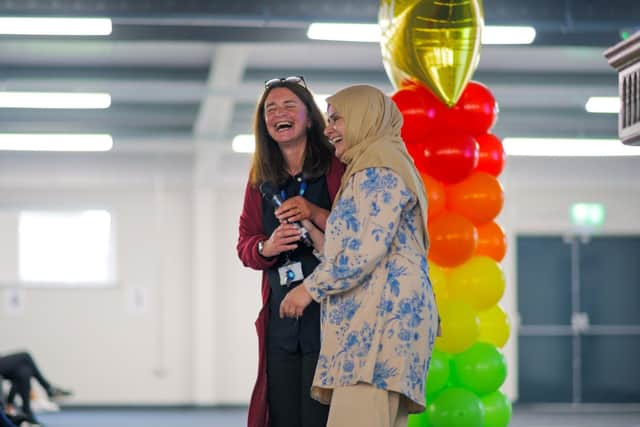

She became a rare kind of leader, one who stepped beyond the school gates. She showed up at local events, listened carefully to parents, and greeted every child and adult at the school gate each morning with warmth and respect. This openness began to shift the school culture. Parents who once stayed away started coming in confidently. Children realised their voices mattered. Staff learned the power of leading with care rather than control.
This change was no accident. It was the result of years of hard work focused on culturally responsive teaching and emotional intelligence. Hilary championed parent-led projects like Book Club and Reach Outdoors, turning them into spaces where equity and connection thrived. What she quietly built in Batley is more than a school, it is a model of social justice in action. And this foundation made possible her most ambitious project yet: the Parent Research Group.
The Parent Research Group at Field Lane Junior School is not just a feel-good story, its impact is backed by solid evidence. It is a grassroots initiative at Field Lane that brings parents, particularly those from multilingual, working-class backgrounds, into a supportive space where they learn, share, and partner with the school to boost their children’s educational success.
During the PRG’s first pilot year, the school participated in the national Prince William Award, which measures traits like confidence and motivation in young children. The results were striking: those pupils whose mothers took part in the group showed the greatest developmental progress.

“It was one of those rare moments where intuition met data,” said headteacher Hilary Towers-Islam. “We realised parental engagement wasn’t just a theory, it was a game-changer.”
This success is particularly notable given Field Lane’s unique challenges. The majority of pupils speak English as an additional language, making it one of the most linguistically diverse primary schools in England. Instead of viewing this as a barrier, the school embraced diversity as a strength, shaping an approach that values culture and community.
The Parent Research Group has attracted attention beyond Batley. Social Scientist, Saira Mirza, from Leeds Trinity University is currently evaluating the initiative as part of her PhD research. Early findings highlight improved parental wellbeing, socioeconomic confidence, stronger community ties, and better educational outcomes for children.
Yet sustaining such a programme is no easy task. Funding for key roles like that of community liaison and Parental Engagement Officer, Amna Farid Qureshi, who runs the sessions comes from limited school budgets, and maintaining the group’s momentum requires ongoing support. Councillor Aziz Daji has helped fund recent sessions, but more investment is needed to expand similar efforts in other schools.
For Hilary, the choice is clear. “This work can’t be an add-on, it has to be part of every school’s core mission,” she said. “If we want to break cycles of disadvantage, we must start here.”
Her advice to other educators is simple: find out who is on the periphery and ask why, the answer often lies in systemic disadvantage, then build trust patiently and bravely. The payoff, she says, is transformative, not just for students’ test scores but for families’ hopes and futures. This is reflected in a lower-than-average proportion of families now eligible for Pupil Premium funding, a socioeconomic shift that speaks not only to changing demographics, but to the long-term impact of Hilary’s leadership in disrupting cycles of disadvantage.
Over time, multiple generations of the same families have passed through Field Lane, each becoming more educationally confident and socioeconomically mobile. It is a quiet, cumulative transformation, proof that with the right leadership, schools can be engines of lasting, intergenerational change.
As one mother wrote to the school: “Yesterday I stopped myself from saying ‘I’m too busy, go play.’ Instead, I turned off the cooker and listened to my child talk about his football cards. Thank you for helping me make this happen.”
Field Lane’s story shows that real change comes from presence, a parent’s time, a school’s openness, a community’s shared commitment. The challenge now is to turn this local success into a movement. Because when schools and families rise together, everyone wins.
A Living Legacy in Batley
As Hilary Towers-Islam prepares to step down after more than three decades in education, Field Lane Junior School stands as a testament not just to her leadership, but to a lasting culture she helped create. This is not a static achievement, but a living legacy, one that embraces families as partners, celebrates diversity, and sees schools as vital community anchors.
At the heart of this legacy is the Parent Research Group, now firmly woven into the fabric of the school. What began as a small, parent-led initiative has grown into a thriving hub of support and collaboration. Amna continues to lead with the empathy and relational approach Hilary championed. Their success is sustained not by mandates or funding alone, but by trust, respect, and the belief that every parent has an important role to play in their child’s education.
Hilary’s departure marks a passing of the torch rather than an end. Former pupils, inspired by their time at Field Lane, are returning as teaching assistants, mentors, and community leaders. Parents who once hesitated now lead workshops and welcome new families. Staff nurtured under Hilary’s guidance are spreading this model of inclusive, culturally responsive education to other schools.
The impact is already spreading beyond Batley. Other schools are looking to replicate Field Lane’s approach, asking how to build trust with marginalised families and foster genuine partnerships rather than tokenistic engagement. Collaboration with Leeds Trinity University means Field Lane’s work is being documented and translated into research that could influence national education policy and teacher training.
In an education landscape often focused on test scores and league tables, Field Lane offers a powerful reminder: meaningful change often begins quietly, with a conversation, a home visit, or a shared cup of tea. Hilary’s vision was never about imposing reform from above, but about nurturing transformation from within, slow, steady, and rooted in community.
Her legacy is a school where families find their voice, children thrive knowing their heritage is valued, and education is built with communities, not inflicted upon them. The true measure of her work is seen not just in statistics, but in lives changed, cycles broken, and futures reimagined.
A Future Rooted in Hope
As Hilary steps away from her role, Field Lane Junior School is not losing a leader, it is carrying forward a vision. What remains is not a gap, but a garden: an ecosystem of shared purpose, cultivated over years of patient, principled work.
The next phase belongs to those once shaped by Hilary’s ethos. Amna, whose journey from volunteer to higher-level teaching assistant, parental engagement officer, and now respected community leader, embodies the very ethos of Field Lane. She continues to lead the Parent Research Group with cultural fluency, deep empathy, and unwavering commitment.
And as Asif Lorgat prepares to step into the role of headteacher, he brings with him both warmth and credibility, qualities honed under Hilary’s mentorship and shaped by the same values of relational leadership, inclusion, and trust that have defined Field Lane’s success.Teachers lead with emotional intelligence; children speak with confidence and curiosity; parents no longer hover on the margins, they are partners in every sense.
What Hilary championed was never perfection, but participation. She believed systems are remade not by edict, but by the steady accumulation of small, human acts: inviting a quiet parent to speak, recognising heritage languages in classroom displays, meeting families where they are, and walking forward with them together.
Field Lane has become a reflection of its community: multilingual, multigenerational, and unafraid to lead with heart. It stands as evidence that equity is not an initiative, but a way of working, a daily practice requiring courage, humility, and, above all, hope.
Hilary’s time as headteacher may be coming to a close, but the story she helped write is still unfolding: in school corridors, on playground benches, in WhatsApp chats, and in bedtime reading circles. It is a story authored not for the community, but with it. And that story is far from finished.